Prologue
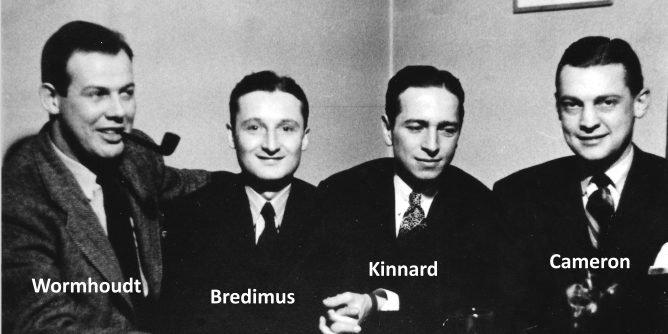
Four life-long friends from Des Moine Iowa gathered in 1974 for old times’ sake and to recite poetry. Hear their voices restored from an audio tape recording. The speakers are Joan Wormhoudt, Bob Bredimus, Bob Wormhoudt, Bob Cameron, Peachy Cameron, Jane Cameron, Owen Kinnard, and Haydee Kinnard.
Poets never really die in the sense that we still hear their voice through recitation of poetry they created in their own speech. That’s the whole point of reading it out loud, or less loud through our inner voice. Dad was a lover of poems, and I have sometimes recalled his warm melodic recitations in a dream. That can be a jolt nearly 50 years after his death. I wondered if there was something more substantial than just a dream, so I took an old audio recording and cleaned it up using A.I. The rendering is free of noise and took me back as if in the same room as the speakers on that old tape recording. I’m posting it here because a next generation of Bredimus family and descendants of his friends might discover it while searching the Web. I’ve made some annotations for search engines for that reason.
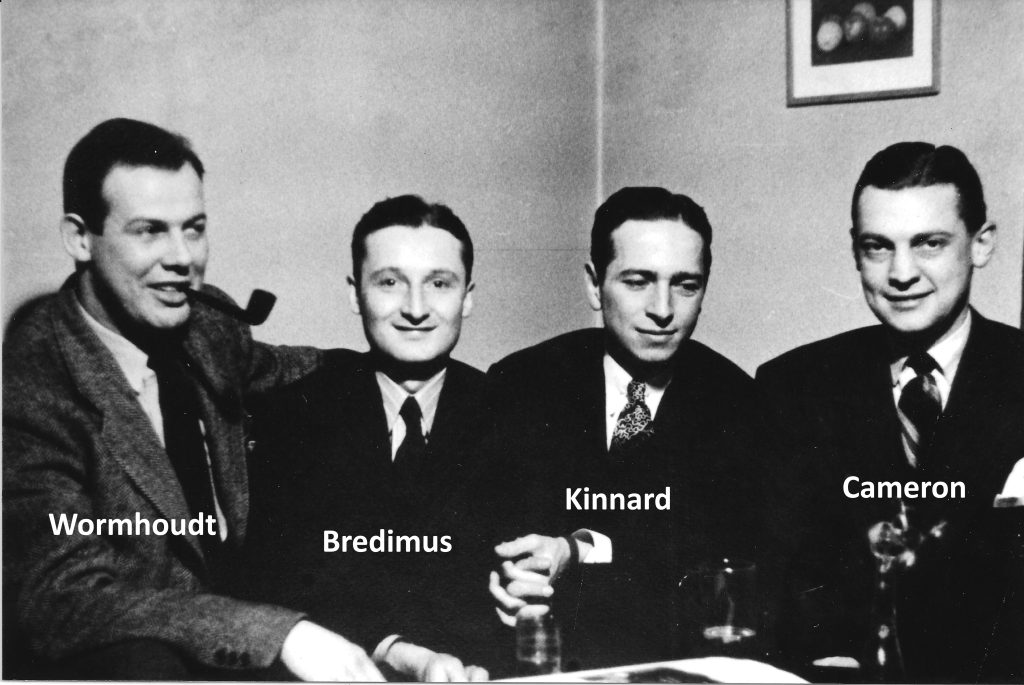
The release of the movie “The Odyssey” was the catalyst to listen to Dad reciting Homer. Hearing his voice, no doubt loosened by alcohol, was a comfortable feeling. I hope other guests reading this post find some comfort as well. Welcome to Bob Bredimus and Friends in 1974! The opening venue is the home of Robert (Bob) Wormhoudt, and his wife Joan Wormhoudt, at their home in Fullerton California. San Franciso and New York were additional stops for the traveling tape recorder. Now, listen in:
Joan Wormhoudt I want to say hello to all the lovely Bredimus boys and girls. Nancy, Cean Robert, Mike, Nick, Bitsy (Mary Elizabeth) and Lynn. Your dad has recorded for us on our tape recorder, the Iliad. We have been talking and it was like forty-two years ago. He did it so well and he would like to record it for you. All you lovely boys and girls. And here he is.
Reciting Homer in Ancient Greek
Bob Bredimus Well, thank you Joan. Uh, Bob Wormhoudt has been the custodian of my Greek textbook for about forty-two years, and he has it here in their home in Fullerton. He has my copy of the Iliad, which I studied with Doctor Sherman Kirk at Drake University so many years ago. Here it is. Mainland II, Thayer, Joe Achilleos and Muriel Chaos all taken. Paulus de cas de Poisson Heron. Otus de Loria took Conessine Oyenusi T Datta Dios de Toledo. Boulet x Sudatta protadius de santé et de. Stay on oxandrolone cardio akhilleus thestar svoi znaki. Latus cardiace. Wheels hogar basilea. New sonar strato nausica. Kane. Olha quanto de la unica chrysin a tomassini aura Terra. This is a translation that Bob Wormhoudt also, uh, took care of for me for all of these years. And I’ll read that now. This is my translation, Bob points out, O goddess, sing the wrath of Peleus son Achilles, the accursed wrath that caused was innumerable to the Achaeans, and set forth many valiant souls of warriors to the realm of Hades, and made them a booty for the dogs and a feast for the birds. But the will of Zeus was being accomplished from the time when first having quarreled, quarreled, they parted both the son of Atreus, king of men, and the divine Achilles. And which of the gods brought these two together in strife to fight the son of Leto and Zeus? For he, having been enraged by the king, kindle an evil plague up through the camp in. The soldiers were being destroyed. That’s that’s about it.
Joan Wormhoudt Wasn’t that lovely? Really? I’m glad Zeus is not around anymore. I’m glad to be in Fullerton in the California is sunshine, by the way. Your father has had lovely sun baths here and has is looking so brown. Well and good. And he’s still cooking very hard for us. Bless his heart. We love him.

Bob Wormhoudt Cooking are we? Uh. And my God, has he cooked? He cooked every night he’d been here. Wait a minute. We’ll talk about the cooking a little bit later. I think. Now we want to go back and hear this.
Bob Bredimus Uh, Bob Wormhoudt and I have been discussing poetry, and, uh, of course, Bob is, uh, probably one of the best poets I’ve ever met, and he knows a great deal about it. But I did bring him to task about his opinion of Percy Bysshe Shelley, and I reminded him of a poem that we read when we were young men and we thought very highly of. And I’m going to read it to you. Oh. All right. Uh, the hymn of Pan. A third verse I sang of the dancing stars. I sang of the daedal earth of heaven and the giant wars and love and death and birth. And then I change my pipings singing how down the vale of Manilius I pursued a maid and clasped a reed. Gods and men, we are all deluded. Thus it breaks in our bosom. And then we bleed. All wept as I think both ye now would. If envy or age had not frozen your blood at the sorrow of my sweet pipings.
Bob Wormhoudt We may have disagreed a little bit about Shelley, but we do not disagree about Keats. And Bredimus is about to read something that all of us must remember in his voice. All.
Bob Bredimus A sonnet written on a blank page in Shakespeare s poems. Facing a lover’s complaint. Bright star would. I were steadfast as thou art not in lone splendor. Hung aloft the night. And watching with eternal lids apart. Like nature’s patient sleepless eremite. The moving waters that their priest like task of pure ablution round Earth’s human shores. Or gazing on the new soft fallen mask of snow. Upon the mountains and the moors. No. Yet still steadfast, still unchangeable. Pillowed upon my fair love’s ripening breast. To feel forever. Its soft fall and swell. Awake forever in a sweet unrest. Still still to hear her tender taken breath. And so live ever or else wound to death.
Bob Wormhoudt And I’m going to read is La Belle Dame Sans Merci and brother and I have been talking about the tutored and the untutored poets. Now I have been claiming for Keats the highest possible skill. And so I’m going to read first just the two lines that begin the poem and try to point out something. The first two lines, I’ll read the whole thing, but the first two lines are are what can heal the wretched white alone and palely loitering. And what you have there in the first line are what can ail. The wretched white is rather a regular iambic figure, but the second line makes. The whole music sets the whole tone for the poem, because alone and palely loitering you have the long vowel after in alone. That makes you stop and listen. And then it it uh, the the, the fall of the meter into alone and palely loitering is a music in a verbal music which suits so perfectly with the sense of the thing that it sets the tone for the whole following poem. Now, let me read the whole poem and see whether alone and palely loitering isn’t the music that we’re hearing all the way through. Ah, what can ail the wretched white alone and palely loitering. The sedge is withered from the lake. And no birds sing. Ah, what can ail thee? Wretched white, so haggard and so will be gone. The squirrels granary is full and the harvest’s done. I see a lily on thy brow. With anguish moist and fever dew. And on thy cheek a fading rose fast withereth. Two. I met the lady in the meads. Full beautiful, a fairy’s child. Her hair was long, her foot was light. And her eyes were wild. I set her on my pacing steed. And nothing else saw. All day long for sideways. Would she lean and sing a fairy song? I made a Garland for her head and bracelets too. And fragrant zone. She looked at me as she did low and made sweet moan. She found me. Roots of relish, sweet and honey, wild and man ado and sure in language strange. She said I love thee true. She took me to her elfin grot. And there she gazed and sighed deep. And there I shut her wild, sad eyes. So kissed to sleep. And there we slumbered on the moss. And there I dreamed of. Woe betide the latest dream I ever dreamed. On the cold hillside I saw pale kings and princes too pale warriors death pale were they all cried, la Belle Dame Summer, she hath thee in thrall. I saw their starved lips in the gloom with horrid warning gaped wide. And I awoke and found me here on the cold hill side. And this is why I sojourn here alone and palely loitering. Though the sedges wither’d from the lake. And no bird sing.
Joan Wormhoudt I have heard some very lovely poetry tonight with Bob Bredimus and Bob Wormhoudt. I have enjoyed it terribly, very much. and it comes to my mind a poem I read and Bob Wormhoudt has recited and read to me. I would love this to be recorded if you could take one minute just to hear it, please.
Other Poets make their presence known
Bob Cameron The Soldier by Rupert Brooke. If I should die, think only this of me that there’s some corner of a foreign field that is forever England. There shall be in that rich earth a richer dust concealed a dust whom England bore, shaped, made aware, gave once her flowers to love her. Ways to roam a body of England’s breathing English air. Washed by the rivers. Blessed by suns of home. And think this heart all evil. Shed away a pulse in the eternal mind no less. Gives somewhere back the thoughts by England. Given her sights and sounds. Dreams happy as her day and laughter. Learnt of friends and gentleness. In hearts at peace under an English heaven. Robert Burns had such a man in mind as my dear friend Bob Bredimus when he wrote this poem about Captain Matthew Henderson. Again, we’re supposed to be reading a man who doesn’t know technique, but it. Wow. Listen. Stop, passenger. My story is brief and truth I shall relate, man. I tell a common tale of grief. For Matthew was a great man. If thou uncommon merit hast yet spurned at Fortune’s door man a look of pity hither cast. For Matthew was a poor man. If thou a noble soldier. Art that passes by this grave man. There molders here a gallant heart. For Matthew was a brave man. If thou. All men. Their works and ways. Canst throw uncommon light. Man here lies. For weal had won thy praise. For Matthew was a bright man. If thou art friendship. Sacred God, what life itself resign, man. The sympathetic tear, mournful for Matthew was a kind man. If thou art staunch without a stain. Like the unchanging blue man. This was a kinsman of iron. For Matthew was a true man. If thou hast wit and fun, and fire a near good wine did fear man. This was thy Billy dam, and sire. For Matthew was a queer man. If only whiggish whinge, and sought to blame poor Matthew. Dear Man may duel and sorrow be his lot, for Matthew was a rare man. But now his radiant courses run. For Matthew’s was a bright one. His soul was like the glorious sun, a matchless, heavenly light man. Now is August the seventh, with bitterness and a good Scotch and coffee, and much remembrance of many very, very dear friends, was particularly the poetry of Vermont. His own, and the recitation of Hopkins and Burns, and of Keats, for my own part, bringing it all back so much to me, I should like to have a few, few things from the poet who probably is most significant to me. William Butler Yeats. Uh, these are quite personal things. Do not probably represent his greatest poems, but I think they are enormously characteristic. And at least there are. They are among those that he himself loved best. The first totally Yeats. This is a dedicatory poem to a house for his wife in Ireland. I, the poet William Yates, with old mill boards and sea green slates and smithy work from the Gort Forge, restored this tower to my wife George, and may these characters remain when all is ruin once again. Somewhat earlier in nineteen oh six. He wrote the following few lines up to the production of the Playboy of the Western world by saying done by the Abbey players in Dublin. It attracted a near unanimity of attack in Ireland. His title was quite simple to those who hated the Playboy of the Western world. Dublin nineteen oh six. Once, when midnight smote the air, eunuchs ran through hell. And met on every crowded street to stare on Great One riding by. Even like these to rail and sweat. Staring upon his sinewy thigh. The next, again, is personal. He called it the lamentation of the old pensioner. Although a shelter from the rain under a broken tree. My chair was nearest to the fire. In every company that talked of love or politics. Air time transfigured me. Though lads are making pikes again. For some conspiracy and crazy rascals rage their fill at human tyranny. My contemplations are of time that has transfigured me. There’s not. A woman turns her face upon a broken tree. And yet the beauties that I loved are in my memory. I spit into the face of time that has transfigured me and for the last, somewhat longer. And again, I would like to emphasize that. I’m not citing these as the very greatest of his poems. They are merely the person. They are merely personally the most significant to me. Were I to single out one for that high accolade, it would probably be sailing to Byzantium. But for my own favorite, my own personal favorite, not merely in Yeats, but perhaps in all the poetry of the Western world. I give Bredimus here, and anyone else who should hear this, the poem that he called to Ireland in the coming times. Know that I would account it be true. Brother of a company that sang to sweeten Ireland’s wrong ballad and story ran and song, nor be I any less of them, because the red rose bordered him of her whose history began before God made the angelic clan trails all about the written page. When time began to rant and rage, the measure of her flying feet made. Ireland’s heart began to beat. And time that all his candles flare to lay, to measure here and there. And may the thoughts of Ireland brood upon a measured quietude. None may I less be counted one with Davis Mangan Ferguson. Because to him who ponders, well, my rhymes more than the rhyming tale of things discovered in the deep. Where only bodies laid asleep for the elemental creatures. Go about my table to and fro. That hurry from unmeasured mind. To rant and rage and flood and whine. Yet he who treads in measured ways may surely barter gays for gays more than ever journeys on with them. After the red rose bordered him are fairies dancing under the moon. A druid land a druid tune. Well still I may I write for you. The love I live. The dream I knew from our birth day until we die is but the winking of an eye. And we are singing. And our love. What measure time is lit above. And all benighted things that go above my table. To and fro. Are passing on to where may be in truth’s consuming ecstasy. No place for love and dream at all. For God goes by with weight. Footfall. I cast my heart into my rhymes. That you and the dim coming times. May know. How my heart went with them. After the red rose bordered him. Some seven months have elapsed since the foregoing was recorded. And now in New York, at what old silver thatch later refers to as the Palatial surroundings of the canards. I dedicate these lines from Humbert Wolfe to our very dear bread, for whom they have a most special significance. Indeed, you cannot dream things lovelier than the first love I had of her. Nor ere is any by magic shaken as her first breath in the first kiss taken. And who in dreaming understands. Her hand stretched like a blind man’s hands open, trembling wise they were. You cannot dream things lovelier. And finally, Joyce, when wines and wines. The shingle. The crazy pear sticks grown a sign. I’ll see numbers. Each single slime silvered stone from whining wind and cold grey sea. I wrap him warm and touch his trembling fine bone, shoulder and boyish arm around the sphere descending darkness of fear above. And in my heart. How deep, unending ache of love.
The venue changes and Bob Cameron’s family speak
Bob Bredimus I am now with my friends Peachy and Bob Cameron and their daughter Jane. And we are sitting out in the kitchen. And I do want to put the voices of my friends on this tape, along with those of my friend Joan and Bob Wormhoudt. Maybe Bob Cameron would say something.
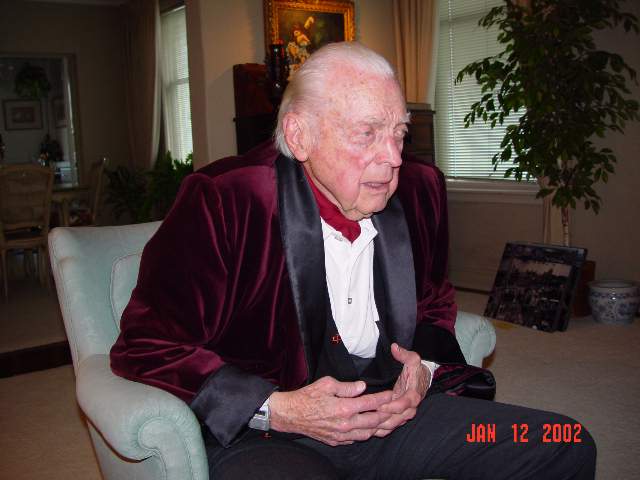
Bob Cameron What I will say now is only to proceed with what Janet is going to read, because I will record later my thoughts. But what she is going to do now is for Wormhoudt and Joan, which is a letter that she received after, uh, Judith Crist had worked with some of her double, double acrostics. Now comes and now comes Janet.
Janet (Peachy) Cameron This is per request. So I’m reading my letter from Judith Crist as was asked of me to do so. Dear Miss Miss Cameron. Others may boast, if boastful, they are. Of their Nobels and Pulitzer and congressional medals. As for my single self to find something familiar about the quote I was working out in November for Saturday review double acrostic to get a prickle of plagiarism and then to get the name and author. Wow. As a lifelong double acrostic, I can only say that my cup of ego overfloweth. I’ve thought of you as a lady of wit and wisdom. Now, I could give you my personal thanks for the breadth of your interests and my very good wishes for the holiday season. Cordially Judith Christ.
Bob Bredimus Thank you very much. Peachy. Jane, would you say something?
Bob Cameron I know Jane and I are going to Oh oh.
Bob Bredimus Jane and her father will record later. So this is all for now.
Jane Cameron is introduced and recites Lewis Carroll – The Jabberwocky
Bob Cameron Ladies and gentlemen, we are most fortunate tonight to have in our midst a much loved guest from the East. Our little daughter, Jane Merrill (Jane Cameron Manoogian) , is here. And though we’ve gone over her repertoire quite carefully, uh, we we feel that the best, the best, the best of Jane is the Jabberwock. Jabberwocky, the Jabberwock, Jabberwock. So, uh, Although I know we impose on her to do this and that she. Is considering being kind to us to do it Nonprofessionally. We will now hear from her. Jane. Would you please.
Jane Cameron I do, please. All right. Twas brillig and the slithy toves did gyre and gimble in the way. All mimsy were the borogoves and the meme raths outgrabe. Mome raths mome raths outgrabe. He took his vorpal sword in hand. Long time the manxome foe. He sought and rested he by the tum-tum tree. And stood a while in thought. And as in Uffish thought he stood. The Jabberwock with eyes of flame came whiffling through the tulgey wood, and Burbled as it came one, two, one, two, and through and through the vorpal blade went snicker snack. He left it dead, and with its head he went galumphing back. Oh, hast thou slain the Jabberwock? Come to my arms, my beamish boy! Callooh callay! O frabjous day! He chortled in his joy. Twas brillig and the slithy toves did gyre and gimble in the way. All mimsy were the borogoves. And the meme raths outgrabe.
Bob Cameron You see, this is Jane speaking.
Jane Cameron This is Jane speaking. Good night and good night. I only missed one.
Another Stop for the Traveling Tape Recorder
Bob Cameron Now we’re back from the Tofuku Tei, which is a restaurant where. Which, uh. In which Mr. Bredimus threatened to abstain from the sashimi. But coming to scoff, he remained a prey and is now back with a stuffed full of dead fish that not even cooked. But delicious. So we’re reluctantly calling a postponement. Not a postponement, but a a recess. In his visit to us in San Francisco, which I think can predict will eventuate in his getting back out here and starting his life. All This before has been prelude, where those cats back there violated him at every turn of the road, and now he’s going to do some patenting of things for himself. How about that bread? At any rate, we’ve been pleased and delighted, and every other word I can think of to have had you here for these few days and hurry back. PostScript. We now take you to the East Coast, and probably to the. To the palatial surroundings of. In Chez Kinnard at. On East fifty fifth Street, where the tape can be. May be finalized. Somebody who’s a good deal better at ad libbing than I am will now take over in the form of Haiti, or own. Or maybe both. Who will sing for you? Indian love call.
Bob Bredimus So here we are, Chez Kinnard, late March, after I have completed my latest world tour. And the next part will be Hade Kinnard. Although no possible inducement that I offered could elicit her version of the Indian love call. Are you all right?
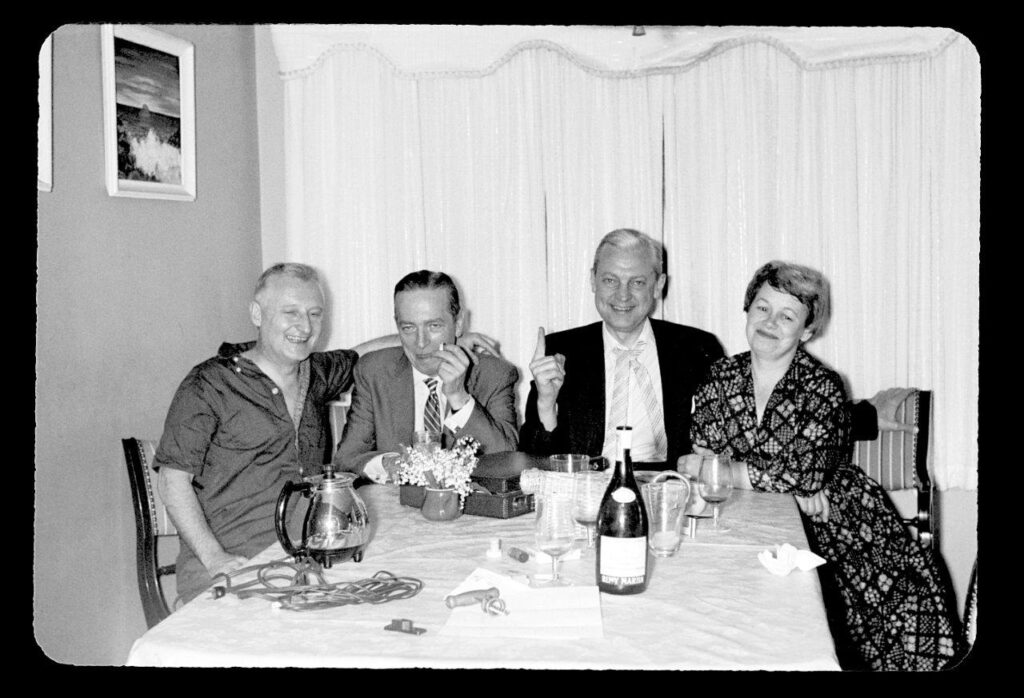
Owen Kinnard I want to eliminate. I want that all I am. Go on now. I am eliminating. No eliminating with this voice track, darling. It’s the only way he can do it.
Bob Bredimus Did you want to hear what they were saying?
Owen Kinnard No, I don’t want this. I want you to pick up and then we’ll go directly to the next tape. At that point, we have a fair amount of space. But all I can say. Let’s turn the tape over. Paying any attention to the slur in this whole business.

Haydee Kinnard Recites Goethe in her Native German
Haydee Kinnard I should like to give you one of the most beautiful poems in in the German language. It is deceptively simple, as is so much by our beloved Johann Wolfgang von Goethe. The poet Speaks of strolling through the woods with nothing particular on his mind. In the shadow of the trees, he sees a small flower shining like a star. And beautiful as the human eye can be. He wants to pick it. When he hears its soft, pleading voice. Shall I be plucked just to die? So he carefully digs it up and carries it to his garden, where he plants it in a quiet spot. Now it thrives and blooms at once. And here it is in the original German version. Gefunden im Walde für mich nicht zu Sehen im Schatten, sah. Ich ein blümlein Sterne. Schon ich wollte sprechen das acts fine soll ich zu sein. Ich glaube. Ich ein Haus und wieder am. IST immer und blüht so far. And in conclusion, I should like to recite a poem by Christina Rossetti that is very dear to me, in part because it was my own discovery for Owen, who has introduced so much English poetry to me. A birthday. My heart is like a singing bird whose nest is in a watered shoot. My heart is like an apple tree whose boughs are bent with thick set fruit. My heart is like a rainbow shell that paddles in a halcyon sea. My heart is gladder than all these. Because my love is come to me, raise me a dears of silk and down. Hang it with bear and purple dyes. Carpeted in doves and pomegranates and peacocks with a hundred eyes. Work it in gold and silver. Grapes in leaves and silver Fleur de lis. Because the birthday of my life is come. My love is coming to me. Beautiful.
Owen Kinnard Great.
Bob Bredimus The other.
Bob Cameron Song John is about to play only a Moment Ago is sung by Toni Arden. It was a record popular when we first met in California in nineteen fifty, and it, we think, has lots of meanings that we wish to cherish, keep and hold on to.
Bob Cameron I have told Bob that I think that. PG Elliot excuse me. PG Cameron would like very much to hear. Tangerine. It seems to me that it really reverberated with the feelings we all had in about nineteen forty three. We find that Joan was hearing it then too, and Red and I and hearing it again. Oh, we really thought that maybe especially peachy might like to hear Tangerine.
Bob Cameron A little too long, too long.
Bob Cameron This is one that I think that Barbara Brand brought over for Peachy when she got the record down at. What was the name of the store in Des Moines? Don’t remember. It was an awfully nice man who ran it, but I think Barbara Brand got this record and brought it over to peachy. And that was the first time she heard it. Then I think a little later she played it for Bob.
Bob Cameron Bredimus knows that his first date was with Peachy. I think maybe that was one of the songs that was played. Maybe, peachy said to Bob. We got to go to the shops. Shops. Plaza. Shops. Cafe. What? What was it called? Uh. And maybe peachy insisted that part of the evening was. I surrender, Dear, by Bing Crosby and Gus Arnheim.
Joan Wormhoudt Hello, Bob. Peachy. Cameron. I love you. I have to say this little thing. We’ve had lovely music. However, I must remember the time when your Bob Cameron loved a girl I loved. Somehow couldn’t stand her. Leonard Feather loved her. And right now, she’ll be in the Hollywood Bowl this coming July. I think she’s lovely. I think Bob Cameron remembers her the way I did.
Keywords – Robert W. Cameron, Tony Cameron of Sausalito, Todd Cameron of Temecula, Tracy Davis of Santa Rosa, Jane Cameron Manoogian of Grosse Pointe, Nina Gruener, Chris Gruener,
Robert H. Wormhoudt, John (Cindie) Wormhoudt of Mammoth Lakes, and Ann (David) Crawford of Gig Harbor, Washington, and her grandchildren, Bill (Donna) and Bob (Darcie) Fennessy, Brendan Crawford; and Tiffany, Gerritt and Tyler Wormhoudt